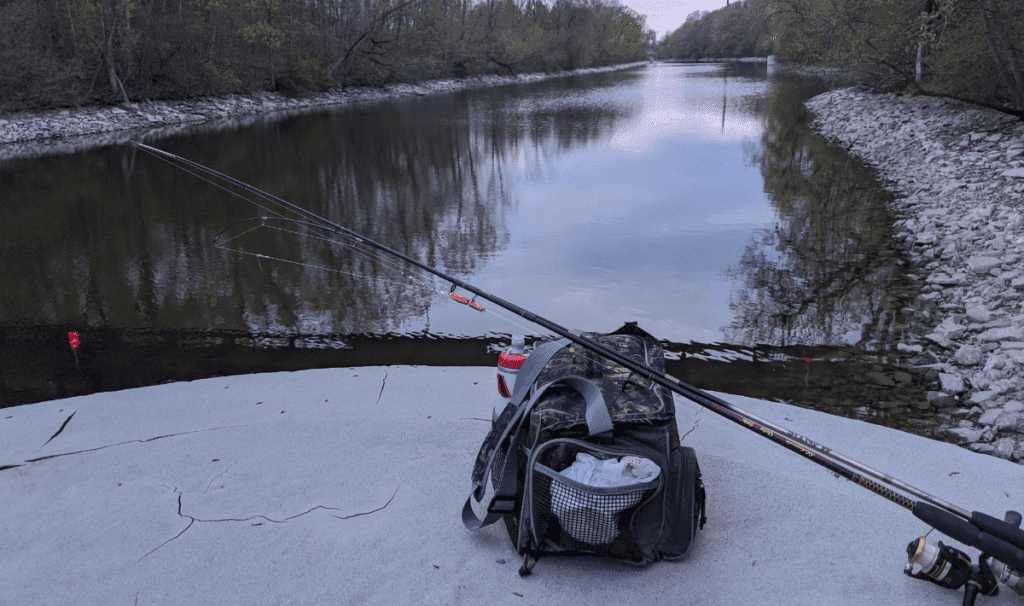
Fishing is one of the few things left in life that refuses to be rushed.
You can’t force the fish to bite.
You can’t speed up the water.
You can’t schedule the exact moment something will happen.
Most of the time, you’re just waiting.
And strangely, that’s exactly why I keep coming back to it.
In a world where everything pushes us to move faster, do more, and produce something measurable, fishing quietly teaches the opposite lesson.
Sometimes the most important thing you can do is simply be there.
Waiting Is the Whole Point
When you first start fishing, waiting feels like the boring part.
You cast the line, sit down, and hope something happens. A few minutes pass and you start wondering if you should move, change bait, or try somewhere else.
But after enough time on the water, something shifts.
You realize the waiting isn’t the empty space between action. It is the activity.
Fishing teaches you to slow down enough to notice what’s around you. The ripple of water moving around a rock. The way insects skim across the surface. The quiet rhythm of wind moving through trees along the bank.
The longer you sit there, the more the world opens up.
Nature Moves at Its Own Pace
Water doesn’t rush.
Rivers carve landscapes slowly. Lakes sit quietly under changing skies. The fish below the surface follow patterns that have nothing to do with our schedules.
When you spend enough time near water, you begin to adjust to that pace.
Your breathing slows. Your thoughts stretch out. Problems that felt urgent an hour ago suddenly feel smaller.
It’s a similar kind of reset I experience when riding through the woods with no plan. I wrote about that in Riding A Bike Just to Get Lost, where the trail becomes less about the destination and more about the process of being present.
Fishing works the same way.
You stop chasing time and start existing within it.
You Learn to Pay Attention
Fishing rewards patience, but it also rewards observation.
You start noticing small details most people miss.
Where the water deepens near the shore.
How shadows move across the surface.
Where insects gather late in the afternoon.
None of these things matter if you’re rushing. But when you slow down enough to watch, they start to make sense.
The longer you fish, the more you realize success has less to do with luck and more to do with paying attention.
And even when the fish don’t bite, the practice of noticing things becomes valuable on its own.
Quiet Is Part of the Experience
Fishing also creates a kind of silence that’s harder to find in everyday life.
Not total silence, but natural quiet.
Water moving.
Birds calling somewhere in the distance.
The soft splash of a line hitting the surface.
Nothing is demanding your attention. Nothing is asking you to respond.
This kind of quiet settles your mind in ways that are hard to describe.
It’s the same kind of calm I wrote about in Choosing Small Repeatable Rituals Outside, where simple time outdoors becomes a daily reset for your thoughts.
Fishing just stretches that moment a little longer.
Productivity Doesn’t Belong Everywhere
One of the biggest lessons fishing taught me is that not everything needs to be productive.
Sometimes you catch fish.
Sometimes you don’t.
But the trip still matters.
Modern life pushes us to measure everything. Steps walked, hours worked, goals completed. Even hobbies get turned into something that needs to be optimized.
Fishing resists that mindset.
You might spend an entire afternoon casting into the water without catching anything. Yet you still come home calmer than when you left.
That alone makes the time worthwhile.
Why I Keep Fishing
After years of fishing, the actual catch has become less important.
Of course it’s exciting when a fish finally bites. The sudden pull on the line still sends a jolt of adrenaline through your body.
But the deeper reason I return to the water goes back much further than that.
In high school I had a good friend I used to fish with all the time. We spent countless hours near the water, sometimes catching fish, sometimes not. Looking back, those days are some of the clearest memories I have.
The quiet of being out in nature was always part of it. The peace of sitting near the water, talking sometimes, sitting in silence other times. But fishing with him also opened the door to how deep the hobby can go.
He seemed to understand the water in a way I didn’t yet.
He knew where fish were likely to be hiding. He paid attention to what they were feeding on. What time of year certain fish would spawn or move through different parts of the river. I learned a lot just by being there and watching how he approached things.
We even started making our own jigs at one point. Nothing fancy, just simple homemade tackle we experimented with. Sometimes they worked, sometimes they didn’t, but that was part of the fun.
That experience showed me something important about fishing.
It can be incredibly simple. You can grab a rod, find a quiet spot by the water, and just enjoy being outside.
But it can also become something deeper if you want it to. Learning the patterns of fish. Understanding the seasons. Paying attention to what they’re feeding on. Even experimenting with making your own lures or jigs.
Fishing grows with you.
Some days I’m still chasing that simple feeling of being outside near the water. Other days I find myself thinking about the details the way my friend used to.
Either way, every trip brings me back to the same thing.
A slower pace.
A quieter mind.
And a reminder that patience is still worth practicing.
Fishing never made me more productive.
But it taught me something better.
How to slow down long enough to actually enjoy where I am.
– Just a note from the yard.