Gardening is only half the equation.
If you don’t preserve what you grow, or what you buy in season you lose most of the financial benefit.
Preserving food isn’t nostalgia.
It’s strategy.
When food is abundant and cheap, you store it.
When prices rise later, you eat from your own shelves and freezer.
That’s how the garden connects directly to our grocery budget.
It’s the same system we outline in How We Feed a Family of 7 on a Budget — structure first, then consistency.
Freezing: The Simplest Way to Start
Freezing is the easiest preservation method and the one we use the most.
It works especially well for:
- Strawberries (like the 20 pounds we’ve picked from local farms)
- Cherries from Wisconsin orchards
- Raspberries and blueberries
- Corn (cut off the cob)
- Blanched green beans
- Portioning meat bought on sale
When we buy fruit at peak season pricing, often directly from the farm, we freeze most of it.
Twenty pounds of strawberries for around $35 goes a long way when:
- Smoothies are made all winter
- Baking uses frozen fruit
- Oatmeal gets topped with berries instead of packaged options
Freezing locks in seasonal pricing.
It also prevents waste.
Freezer space is one of the most powerful budget tools we own.
Freezer-based batch cooking also ties directly into Bulk Cooking, Freezing, and Feeding a Big Family Without Burning Out.
If you’re curious about the specific equipment we use to make bulk freezing manageable, I break that down in Essential Kitchen Tools for Feeding a Large Family.
Canning: Shelf-Stable Security
Freezing is convenient.
Canning is security.
We typically can:
- Tomato sauce from garden tomatoes
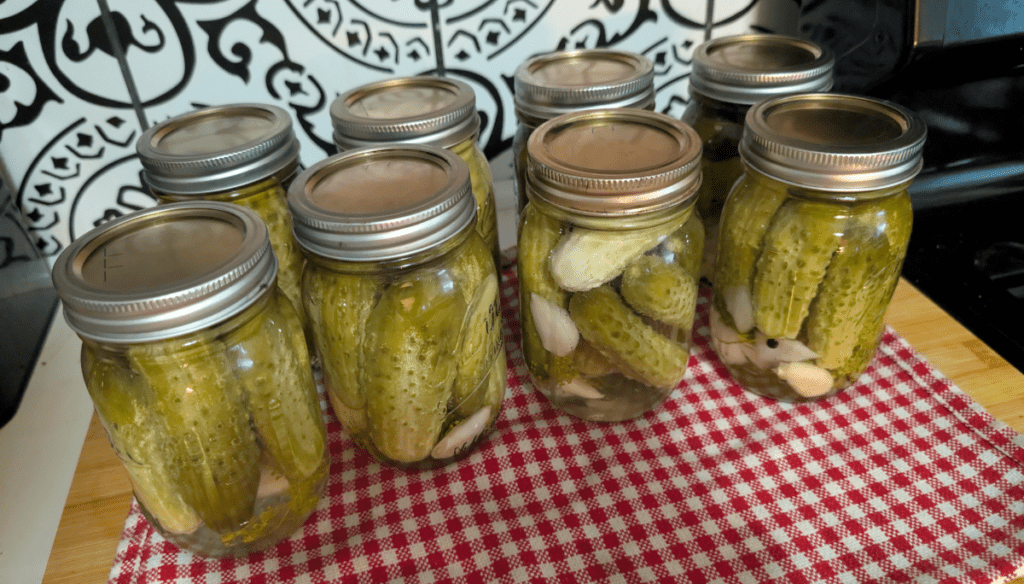
- Pickles from cucumbers
- Salsa from tomatoes and peppers.
- Jam from strawberries, raspberries and cherries.
There are two basic methods:
Water bath canning – for high-acid foods like tomatoes and fruit.
Pressure canning – for low-acid foods like certain vegetables and meats.
You don’t need to start big.
Even a few jars of tomato sauce or jam on the shelf:
- Reduce winter grocery spending
- Improve food quality
- Give you flexibility when meal planning
Those jars become future meals.
Dehydrating Peppers for Long-Term Storage
Every few years, we grow hot peppers:
- Habanero
- Jalapeño
- Cowhorn (a large cayenne variety)
Instead of trying to use them all fresh, we dehydrate most of them.
Using a simple dehydrator, we dry them completely and store them in airtight containers.
Properly dehydrated peppers can last for years.
I’m still using dried habaneros and jalapeños from a harvest three years ago.
Once dried, they can be:
- Crushed into flakes
- Ground into powder
- Rehydrated for sauces
- Added directly into salsa and soups
Dehydrating is one of the simplest long-term preservation methods. It requires little space, very little maintenance, and it preserves intense flavor for years.
Buying in Season and Preserving From the Source
Not everything we preserve comes from our backyard.
Some of it comes directly from local farms and orchards.
Living in Wisconsin, we take advantage of peak season:
- Cherry picking
- Apple orchards
- Bulk strawberries
- Other fruit that’s abundant locally
- You could even forage in the woods for free, blackberries and raspberries are abundant here and if you know where to look its ripe for the picking!
When you go straight to the source and buy in bulk, pricing drops dramatically compared to grocery store packaging.
That abundance is temporary.
Preserving turns it into year-round access.
You can apply this anywhere:
- Apples in the Midwest
- Blueberries in the Northeast
- Citrus in the South
- Whatever grows heavily in your region
The strategy isn’t “grow everything yourself.”
It’s: buy or grow when food is abundant, preserve it, and eat from that supply later.
We talk more about sourcing food this way in How We Grow and Use Our Garden Year-Round, because not everything has to come from your backyard to benefit your budget.
Why Preserving Is Financially Powerful
Here’s what preserving really does:
- Reduces impulse grocery trips
- Stabilizes your food supply
- Shields you from seasonal price spikes
- Turns labor into long-term savings
A freezer full of fruit and a shelf of canned tomatoes changes how you shop.
Instead of reacting to grocery store prices, you supplement them.
Instead of buying small plastic containers of berries in January, you open your freezer.
Preserving doesn’t eliminate grocery spending.
It reduces dependence on peak pricing.
Preserving Without Burning Out
You don’t have to can 200 jars.
You don’t have to grow acres.
Start small:
- Freeze 10 pounds of fruit.
- Can a batch of tomato sauce.
- Dehydrate peppers once every few years.
Preserving is part of the same system we use for:
- Bulk cooking
- Scratch meals
- Budget stability
It’s not about perfection.
It’s about consistency.
Final Thoughts
Gardening gives you food.
Preserving gives you time.
Time between harvest and winter.
Time between abundance and scarcity.
Time between grocery price swings.
You don’t need to do everything.
You just need to think seasonally.
Grow some.
Buy some at peak season.
Preserve what you can.
And eat from it later.
– Just a note from the yard.